Low‑GI and low‑GL eating patterns (more "slow carbs", fewer rapid‑spike foods) reliably bring HbA1c down by about a third of a percentage point on average in people with diabetes, and also modestly improve fasting glucose, lipids, blood pressure and inflammation — but portion size and overall balance still matter, so "low GI" is a tool, not a magic label.
"Low GI" gets used as if it were a marketing claim — sometimes accurately, sometimes not. The underlying idea is more useful than the supermarket label suggests.
What GI and GL actually mean
The glycaemic index (GI) ranks a carbohydrate food by how quickly it raises blood sugar, on a scale where pure glucose is 100. A lower number means the food's sugar arrives more gradually; a higher number means it arrives faster.
The glycaemic load (GL) takes the GI and multiplies it by the actual amount of carbohydrate in a normal serving. It answers a more useful real-life question: given how much of this food I'm actually going to eat, how big is the blood-sugar wave likely to be?
A small example: watermelon has a high GI, but a normal slice contains very little carbohydrate, so its GL is modest. White rice has a high GI and people often eat a large portion, so its GL is high. The two together tell a more honest story than GI alone.
What low‑GI eating actually does
Across many randomised trials in people with diabetes, eating in a low-GI or low-GL pattern lowers HbA1c by about a third of a percentage point on average, and also produces modest improvements in fasting glucose, blood lipids, blood pressure and markers of inflammation.1
A third of a percentage point sounds small. In practice, it's roughly the kind of HbA1c change you'd hope to see from adding a single moderately-effective lever — useful, real, and worth doing, especially because the same change tends to nudge several other markers in the right direction at the same time.
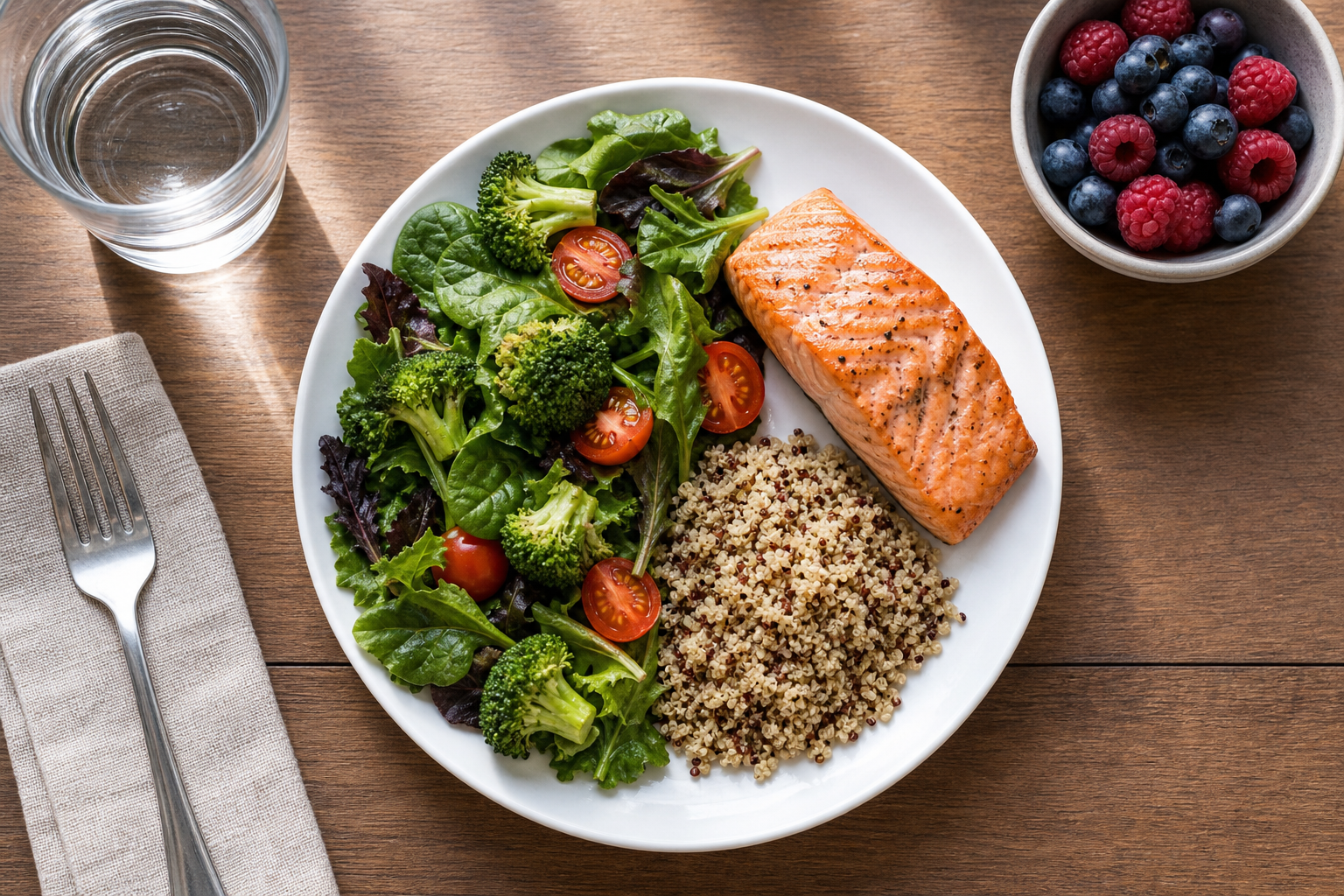
The current framing in medical nutrition therapy for diabetes treats low-GI as one tool inside a broader pattern (more vegetables, more fibre, more whole foods) rather than a diet of its own.2 That's worth holding onto: "I switched to low-GI bread" is not the same intervention as "I rebuilt the shape of my plate".
What GI doesn't tell you
A few honest limits:
- Portion size still matters. A "low-GI" food eaten in a very large portion can produce a bigger wave than a moderate portion of a higher-GI food. GL captures part of this; common sense captures the rest.
- Mixed meals behave differently from single foods. The GI of a food is measured in isolation. Once you add protein, fat and fibre alongside it (eggs with toast, chicken with rice), the actual blood-sugar response is usually flatter than the GI number alone would predict.
- Individual variability is real. Two people can eat the same bowl of oats and produce noticeably different glucose curves. GI is a population average, not a personal forecast.
- "Low GI" on a label is not a free pass. A heavily processed snack can be low-GI and still not be a great everyday food.
How to use this without memorising tables
You don't need to carry a GI chart around. A few patterns get you most of the benefit:
- Choose less-refined carbs more often: oats, barley, beans and lentils, whole-grain breads, brown or red rice some of the time.
- Treat very fast carbs — sweet drinks, white bread, white rice in large portions, sugary breakfast pastries — as occasional rather than default.
- Whenever you do eat a faster carb, add slowing-down company: vegetables, protein, healthy fat, plain dairy.
- Walk for 10–15 minutes after the meal that usually pushes your blood sugar up the most. (We've written about this in how a post-meal walk helps blood sugar.)
If you're not sure where to begin, Glukky is a small companion app that handles the above for you.
If you'd like the matching everyday numbers — what counts as "in range" before and after meals — see blood sugar targets after meals. For where fruit fits in the picture, see fruit and blood sugar.